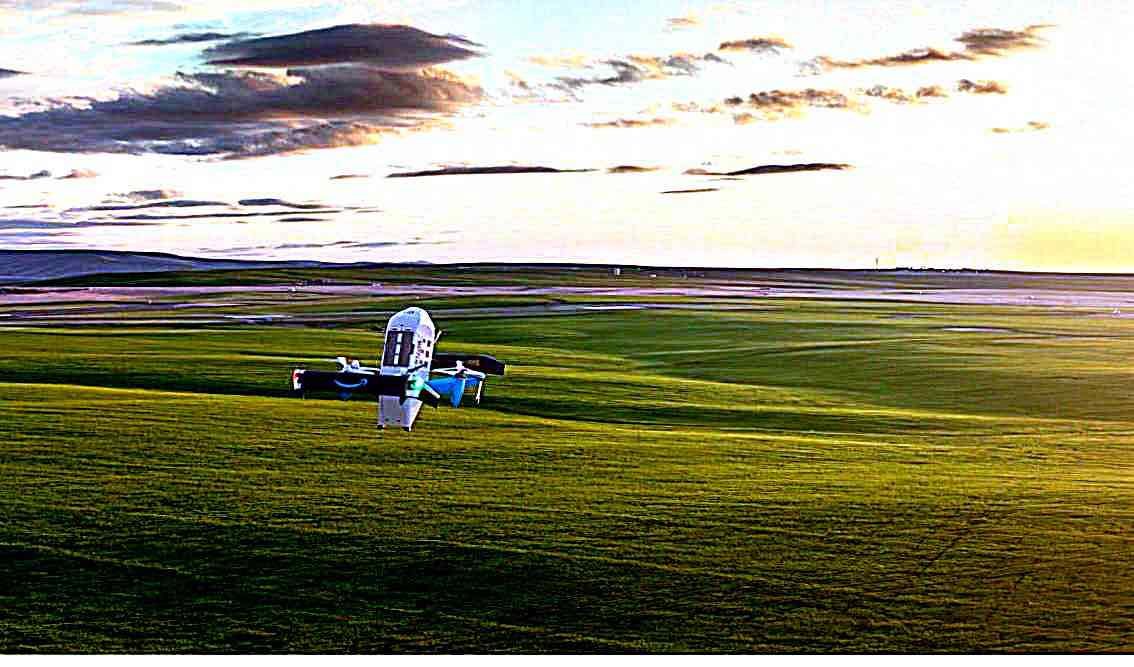
Imagine placing an order online and, instead of waiting for a delivery van, seeing a small drone arrive near your home with your package. It may sound like something from a science-fiction movie, but this idea is becoming a reality through Amazon Prime Air.
Prime Air offers a fascinating example of an emerging concept called Physical AI—AI that does not remain confined to a computer screen but can sense the world around it, make decisions, and take action in the physical environment. By bringing together cameras, sensors, computer vision, autonomous flight technologies, and machine-learning capabilities, Prime Air shows how artificial intelligence is beginning to interact with the real world.
Amazon plans to expand Prime Air across the United States, targeting nearly 500 cities and towns by the end of 2026. As of August 2026, Prime Air operates from 11 U.S. locations across 10 metropolitan areas, with additional locations planned. Amazon says the service has already delivered hundreds of thousands of packages by drone this year.
- How Does It Work?
A Prime Air drone is much more than a flying vehicle carrying a package. It needs to understand what is happening around it and respond appropriately.
The drone uses cameras, sensors, computer vision, and autonomous flight technologies to observe its surroundings and navigate safely. One of its important capabilities is Detect-and-Avoid, which enables the drone to independently monitor its airspace and make real-time safety decisions.
There is another important moment just before the package reaches its destination. The drone checks the delivery area to make sure that people, pets, and vehicles are not in the way before safely releasing the package.
Put simply, the drone has to sense, understand, plan, and act. That simple sequence captures the basic idea behind Physical AI: intelligence that can interact with the physical world.
- Fast and Convenient Delivery
One of the biggest attractions of Prime Air is speed. Amazon says eligible orders can arrive in as fast as 30 minutes, although most current orders arrive in around 60 minutes.
The service supports eligible items weighing 5 pounds (2.27 kg) or less that can fit within the drone's delivery requirements. These include products such as groceries, electronics, cosmetics, medications, and household items.
For a customer who suddenly needs a small item, this could make a real difference. Instead of waiting for a vehicle to travel through roads and traffic, a drone can take a direct route through the air to the designated delivery location.
- Humans Still Matter
It is easy to hear the word “autonomous” and imagine machines doing everything on their own. In reality, people remain an important part of the entire system.
Engineers design the drones and their software. Other professionals work on sensors, navigation, safety, maintenance, operations, and regulatory compliance. Humans also monitor systems and handle situations where human judgment is needed.
This is an important point when we talk about the future of AI. Intelligent machines may become capable of performing more tasks independently, but humans still design them, set their goals, supervise their operation, and take responsibility for how they are used.
The future is therefore not simply about machines replacing people. It is about people working alongside increasingly capable intelligent systems.
- Safety and Challenges
Getting a drone into the air is one thing. Making it operate safely around people, buildings, vehicles, and other aircraft is a much bigger challenge.
Prime Air has to deal with changing weather conditions, airspace management, battery limitations, privacy concerns, noise, regulatory requirements, and the reliability of autonomous decision-making.
Consider what happens when an unexpected obstacle appears or conditions suddenly change. The drone needs to detect the change, understand the situation, determine an appropriate response, and continue its journey safely. This makes reliable sensing, perception, navigation, and safety mechanisms essential.
Package protection is also an important part of Prime Air. Amazon uses customized Prime Air boxes with cushioning technology at the bottom to protect items during delivery. Each package is secured in a compartment on the underside of the drone during transit.
Prime Air operates under FAA Part 135 certification, the regulatory framework used for commercial air-carrier operations. The FAA states that operators conducting small-package drone delivery must use the Part 135 certification process and obtain the necessary authorization or waiver for beyond-visual-line-of-sight operations.
Technology alone, however, will not determine the success of drone delivery. People also need to trust these systems. For drones to become a normal part of everyday life, they must be safe, reliable, responsible, and respectful of the communities in which they operate.
- More Than Drone Delivery
Prime Air is particularly interesting from a Computer Science and Engineering perspective because it demonstrates Physical AI in action.
Most of us encounter AI through digital applications—chatbots, recommendation systems, search engines, image recognition, and other software. Physical AI takes the idea a step further by connecting intelligence to machines that can perceive their surroundings, make decisions, and act in the physical world.
A delivery drone brings together several important areas of Computer Science and Engineering. Artificial Intelligence enables intelligent decision-making, computer vision helps the drone perceive and interpret its surroundings, robotics and autonomous systems enable physical movement and control, while sensors and communication technologies provide real-time environmental and operational information. Together, these technologies support autonomous navigation, obstacle avoidance, safe package delivery, and efficient logistics.
- Why Does It Matter?
The significance of Prime Air goes beyond getting a package delivered faster.
It shows how computing can be used to rethink familiar processes and create new possibilities in logistics. It also opens opportunities for engineers and professionals working in AI, robotics, software development, computer vision, embedded systems, autonomous navigation, safety engineering, and logistics.
More importantly, it makes us think about an important question:
As machines become better at sensing and acting independently, how should humans design, control, and supervise them responsibly?
That question will become increasingly important as Physical AI moves into more areas of everyday life.
- The Road Ahead
Drone delivery is still evolving. Its future will depend not only on advances in technology but also on safety, reliability, regulation, infrastructure, economics, and public acceptance.
Amazon Prime Air gives us a glimpse of a future in which intelligent machines can move through the physical world and perform useful tasks with increasing levels of autonomy. But the bigger story is not really about drones.
It is about the changing nature of computing.
Physical AI represents a shift from systems that primarily process information to systems that can perceive their surroundings, make decisions, and take meaningful action in the physical world.
So, the next time we ask,
“Where is my package?”
The answer might not simply be:
“It’s on the way.”
It might be:
“It’s flying to you.”