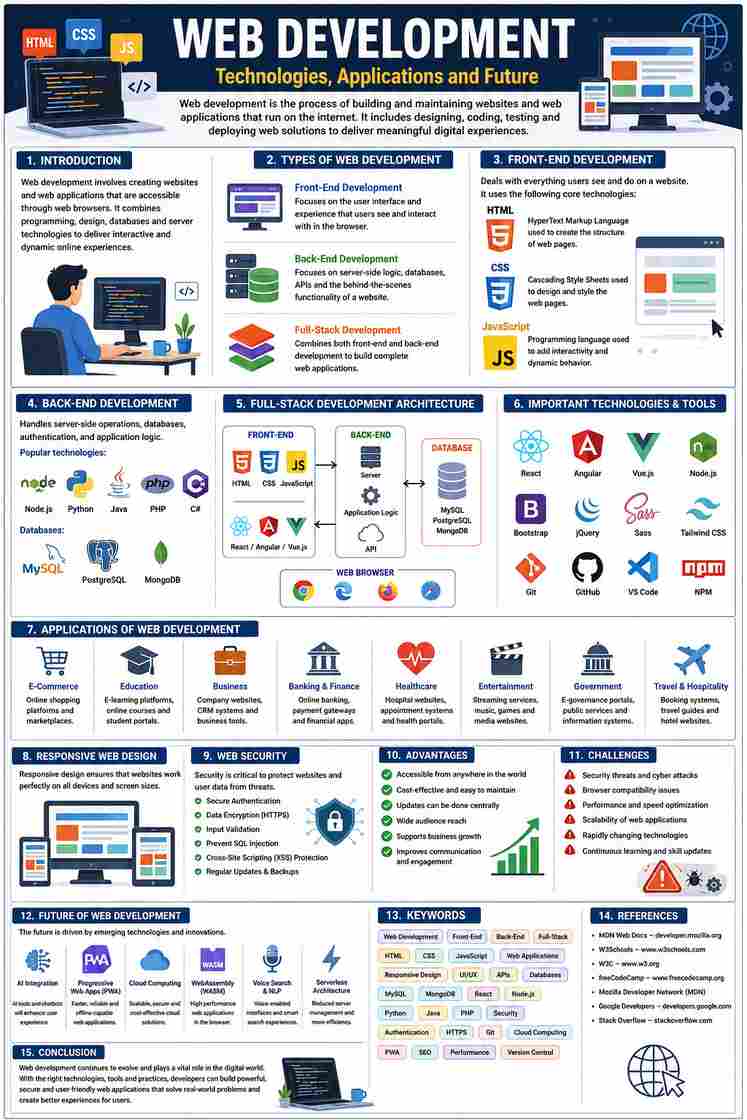
Web Development – Building the Digital World
Introduction
In today's world, the internet has become a part of our everyday life. We use websites and web applications for almost everything, from shopping and banking to learning, entertainment, and communication. Behind all these services is a field called Web Development.
Web development is the process of creating and maintaining websites and web applications. It involves different technologies, programming languages, databases, and tools that work together to provide a useful and interactive experience for users.
What is Web Development?
Web development refers to the work involved in building websites and applications that run through a web browser. A web developer is responsible for making a website functional, attractive, fast, and easy to use.
Web development is generally divided into three main areas: Front-End Development, Back-End Development, and Full-Stack Development.
Front-End Development
Front-end development is the part of a website that users can see and interact with. It includes elements such as buttons, menus, images, forms, text, and page layouts.
The three basic technologies used in front-end development are:
- HTML – Creates the structure of a webpage.
- CSS – Adds style, colors, layouts, and designs.
- JavaScript – Adds interaction and dynamic features.
For example, when we click a button on a website and something happens immediately without opening another page, JavaScript is often responsible for that interaction.
Back-End Development
Back-end development works behind the scenes. Users may not directly see it, but it is responsible for processing requests, managing data, handling login systems, and communicating with databases.
Popular back-end technologies include Java, Python, PHP, JavaScript/Node.js, and C#. Databases such as MySQL, PostgreSQL, and MongoDB are commonly used to store information.
For example, when a user logs into an online shopping website, the back-end checks the login details and retrieves the user's account information from the database.
Full-Stack Development
Full-stack development combines both front-end and back-end development. A full-stack developer works on different parts of a web application, including the user interface, server-side logic, APIs, and databases.
This makes full-stack development useful for creating complete web applications from start to finish.
Important Technologies Used in Web Development
Web development has a large number of technologies and tools. Some of the commonly used ones are:
- HTML
- CSS
- JavaScript
- React
- Angular
- Vue.js
- Node.js
- Java
- Python
- PHP
- MySQL
- MongoDB
- Git and GitHub
Frameworks and libraries make development easier by providing ready-made features and structures that developers can use in their projects.
Applications of Web Development
Web development is used in almost every field today. Some common examples include:
E-Commerce: Websites such as online shopping platforms allow users to search for products, place orders, and make payments.
Education: Schools and colleges use websites and web applications for online classes, examinations, assignments, and student management.
Banking: Online banking systems allow customers to check balances, transfer money, and manage their accounts through websites.
Healthcare: Hospitals use web applications for appointments, patient records, billing, and other services.
Entertainment: Streaming platforms, online games, and social media websites are also developed using web technologies.
Responsive Web Design
People access websites using different devices such as mobile phones, tablets, laptops, and desktop computers. Responsive web design ensures that a website adjusts itself according to the screen size.
A good website should be easy to use on both a large computer screen and a small mobile phone. This improves the overall user experience.
Web Security
Security is another important part of web development. Websites often handle sensitive information such as passwords, personal details, and payment information. Therefore, developers need to protect web applications from security threats.
Some important security practices include secure authentication, HTTPS, input validation, encryption, regular updates, and protection against attacks such as SQL injection and cross-site scripting.
Advantages of Web Development
Web development provides many benefits in modern society:
- Websites can be accessed from anywhere with an internet connection.
- Businesses can reach customers worldwide.
- Web applications can reduce manual work.
- Information can be updated quickly.
- Online services make many tasks faster and more convenient.
- Businesses can communicate with customers more effectively.
Challenges in Web Development
Although web development offers many benefits, developers also face several challenges. Websites need to work correctly across different browsers and devices. Security threats are constantly changing, so applications need regular updates and protection.
Developers also have to keep learning because new programming languages, frameworks, tools, and technologies are introduced regularly.
Future of Web Development
The future of web development is closely connected with technologies such as Artificial Intelligence, Cloud Computing, WebAssembly, Progressive Web Apps, and advanced cybersecurity.
AI is already helping developers with tasks such as code generation, testing, debugging, and personalization. In the future, websites may become more intelligent and capable of providing experiences based on individual user needs.