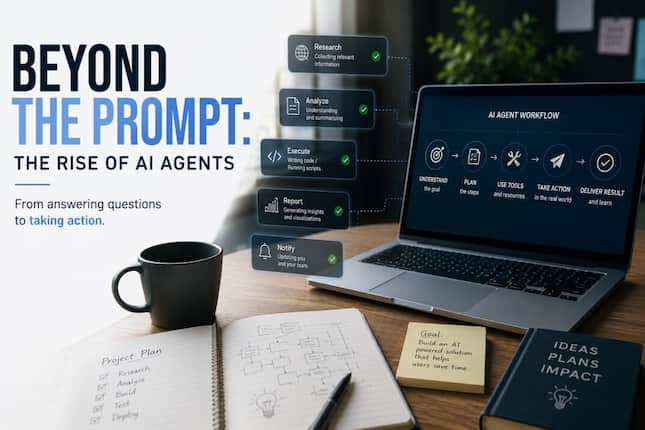
Beyond the Prompt: When AI Learns to Take Action
Imagine having your own JARVIS.
You tell it, “I need to prepare for tomorrow’s presentation.” Instead of just giving you a few tips, it searches for information, organizes your material, creates a presentation, checks it for mistakes, and reminds you about the meeting.
Sounds like science fiction?
Not anymore.
Artificial Intelligence is entering a new phase. Instead of simply answering questions, some AI systems are being designed to understand goals, plan tasks, use digital tools, and take action with much less step-by-step guidance from humans.
These systems are known as AI agents.
From “Tell Me” to “Do It”
Most of us are already familiar with AI chatbots. We type a prompt, the AI processes it, and we get an answer.
For example, ask:
“Explain binary search.”
The AI explains it.
But what if you say:
“Build a small application that helps students practice binary search.”
An AI agent could potentially break that goal into smaller tasks, design the application, write the code, test it, find errors, fix them, and deliver the finished result.
That is the basic idea behind agentic AI.
The shift is simple: from generating a response to actually working towards a goal.
So, What Is an AI Agent?
An AI agent is a software system that can understand a goal, decide what needs to be done, use different tools, observe the results, and change its approach when necessary.
A simple way to look at it is:
Goal → Understand → Plan → Act → Observe → Adapt
For example, instead of asking an AI:
“What are some good laptops for programming?”
you could give an agent a more specific goal:
“Find me the best programming laptop under ₹70,000.”
The agent could search for available laptops, compare their specifications and prices, check them against your requirements, and give you a shortlist.
You provide the goal. The agent figures out the steps.
How Do AI Agents Work?
AI agents usually bring together several technologies.
A Large Language Model (LLM) helps the system understand instructions and reason about what needs to be done. External tools such as websites, databases, APIs, search engines, and coding environments allow it to actually perform tasks.
For example, a coding agent might work like this:
Understand the problem → Inspect the code → Find the issue → Modify the code → Run tests → Check the results → Fix errors
Unlike a chatbot that gives one answer and stops, an agent can continue through several steps, using the result of one action to decide what to do next.
Where Can They Be Used?
💻 Software Development
AI agents can help developers with coding, debugging, testing, documentation, and understanding existing code. Instead of writing everything manually, developers may increasingly focus on describing what they want to build while AI helps handle different stages of development.
📚 Education
An AI learning agent could track a student's progress, identify weak areas, generate practice questions, explain difficult concepts in different ways, and adjust a study plan based on performance.
🏢 Business
Businesses could use agents to automate repetitive tasks such as processing documents, analyzing reports, responding to routine requests, and transferring information between different applications.
🔬 Research
AI agents could help researchers gather information, compare sources, organize data, and handle repetitive parts of the research process, leaving more time for deeper analysis.
But Should AI Be Allowed to Act?
Greater autonomy also means greater responsibility.
If an AI gives you a wrong answer, you can simply ignore it. But if an AI agent takes the wrong action, the consequences can be much more serious.
An agent connected to a database, financial system, or company network could create significant problems if it misunderstands its instructions.
That is why security, privacy, reliability, permissions, and human oversight are so important.
The goal should not be to make AI autonomous just because it can be. The goal should be to make it usefully autonomous while keeping humans in control of important decisions.
What Does This Mean for CSE Students?
The rise of AI agents is especially important for Computer Science students.
Future developers may spend less time writing every single line of code manually and more time designing systems, defining requirements, reviewing AI-generated code, testing applications, and solving complex problems.
That does not make Computer Science fundamentals less important. In fact, it makes them even more valuable.
Knowledge of data structures, algorithms, databases, operating systems, cybersecurity, and software engineering helps engineers understand what AI-generated systems are doing and, more importantly, whether they are doing it correctly.
AI can generate code. But someone still needs to understand the code.
Beyond the Prompt
We are moving from computers that simply follow instructions toward systems that can understand goals and take action.
AI agents are an important step in that evolution.
For Computer Science engineers, this is more than just another technology to learn. It offers a glimpse into how software itself could change.
The future may not be about telling computers exactly what to do at every step.
It may be about giving them a goal—and designing intelligent systems that can figure out how to get there.
The prompt was only the beginning.