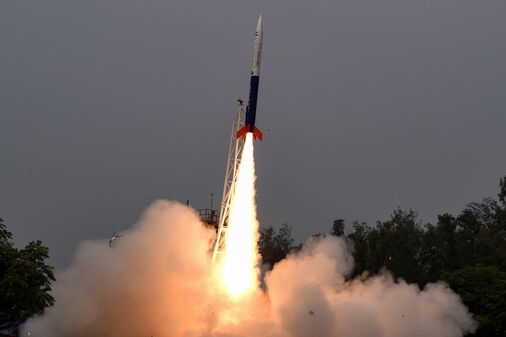
Vikram-1, named after the famous Indian space scientist Dr. Vikram Sarabhai, stands 22 meters tall and is a three-stage launch vehicle that can deliver payloads weighing up to 350 kg into Low Earth Orbit (LEO). This rocket features a range of homegrown technologies, such as cutting-edge 3D-printed rocket engines, lightweight composite materials, and precise guidance systems, showcasing India's advancing skills in modern aerospace engineering.
The first mission, called Mission Aagaman, successfully launched six customer payloads into an orbit roughly 450 km above the Earth. The rocket achieved its target orbit just minutes after liftoff, proving the effectiveness of its propulsion, navigation, and stage separation systems. This successful orbital mission positions India among a select few nations where private companies have shown they can independently achieve orbital launch capabilities.
The success of Vikram-1 is more than just a tech win. It highlights how effective India's space-sector reforms from 2020 have been, which opened the door for private players and fostered collaboration with ISRO. These public-private partnerships are set to boost India's standing in the global commercial launch scene, spark innovation, draw in investments, and create fresh opportunities for scientific research and satellite launches.
The successful launch of Vikram-1 is a moment of pride for India, showcasing the nation's knack for blending government know-how with private sector creativity. As more Indian startups dive into the space game, missions like Vikram-1 are paving the way for cost-effective satellite launches, cutting-edge space tech, and a more significant role in the global space economy.
The primary purpose of the Vikram-1 mission (Mission Aagaman) was not scientific exploration, but to demonstrate and validate India's first privately developed orbital launch vehicle under real flight conditions. It was essentially a technology demonstration and commercial qualification mission.
- Validate the Vikram-1 rocket
- Test the rocket's propulsion systems.
- Verify stage separation.
- Validate guidance, navigation, control, telemetry, and avionics during an actual orbital launch.
- Collect flight data to improve future versions of the vehicle.
- Deploy customer payloads into orbit
- Successfully place multiple Indian and international payloads into a 450 km Low Earth Orbit (LEO).
- Demonstrate that Skyroot can provide reliable commercial launch services for small satellites.
- Support India's commercial space industry
- Showcase that an Indian private company can independently build and operate an orbital launch vehicle.
- Position India as a competitive player in the global small-satellite launch market.
- Demonstrate advanced indigenous technologies
- Test the performance of:
- 3D-printed rocket engines
- Carbon-composite structures
- Indigenous avionics and flight software
- Precision orbital insertion systems
- Test the performance of:
- Validate payload technologies
The mission also carried technology demonstration payloads, including:- SCOPE (Skyroot) – experimental satellite technologies.
- SOLARAS (Grahaa Space) – satellite technology demonstration.
- Embrace (Cosmoserve Space) – robotic arm technology for future space-debris removal.
- DCUBED payloads (Germany) – in-orbit technology demonstrations.
The Vikram-1 mission proved that an Indian private company can successfully build, launch, and place satellites into orbit. This achievement opens the door for regular commercial satellite launches from India and marks the beginning of a new era in the country's private space industry.