| Place of visit | CSIR – National Institute of Oceanography (NIO), Raj Bhavan Rd, Dona Paula Jetty, Panaji, Goa |
| Date of visit | 9 October 2026 (Friday) |
| Participants | Students of B.Tech Computer Science and Engineering |
| Number of students | 41 |
| Faculty accompanying | Dr. Juby Raju and Prof. Selvan P |
| POs and PSOs mapped | PO5, PO6, PO7, PO10, PO12, PSO1, PSO2 |
1. Introduction
Educational and industrial visits give engineering students an opportunity to see how the concepts studied in the classroom are applied in real working environments. With this aim, the Department of Computer Science and Engineering organised a visit to CSIR – National Institute of Oceanography (NIO), Dona Paula, Goa, for 41 students on 9 October 2026. The visit exposed students to a national research institution and to the role of science, technology and computing in ocean research.
2. About the Organisation
CSIR – National Institute of Oceanography is a national research institute under the Council of Scientific and Industrial Research (CSIR), headquartered at Dona Paula, Goa. The institute carries out research in the physical, chemical, biological and geological aspects of the oceans and in related ocean technology and instrumentation. A visit to the institute helps students see how scientific research is organised and how technology supports the study of the ocean and the environment.
3. Objectives of the Visit
- To expose students to a national research institution and its research facilities.
- To familiarise students with ocean science and the technologies used in ocean research.
- To help students see how computing, sensors and data support scientific and environmental work.
- To encourage curiosity, research interest and awareness of career opportunities in research.
4. Visit Details
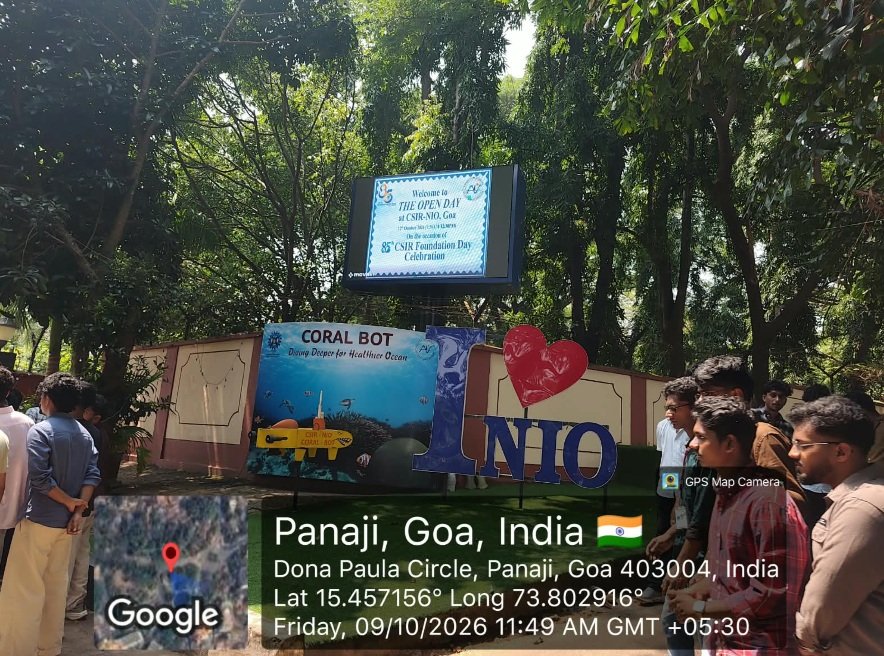
The students, accompanied by Dr. Juby Raju and Prof. Selvan P, reached CSIR-NIO, Goa, on the morning of 9 October 2026. The visit coincided with the Open Day held at the institute on the occasion of the 85th CSIR Foundation Day celebration. At the entrance, the students saw the exhibit on the Coral Bot, an underwater robotic platform for coral and ocean studies, displayed under the theme of a healthier ocean.
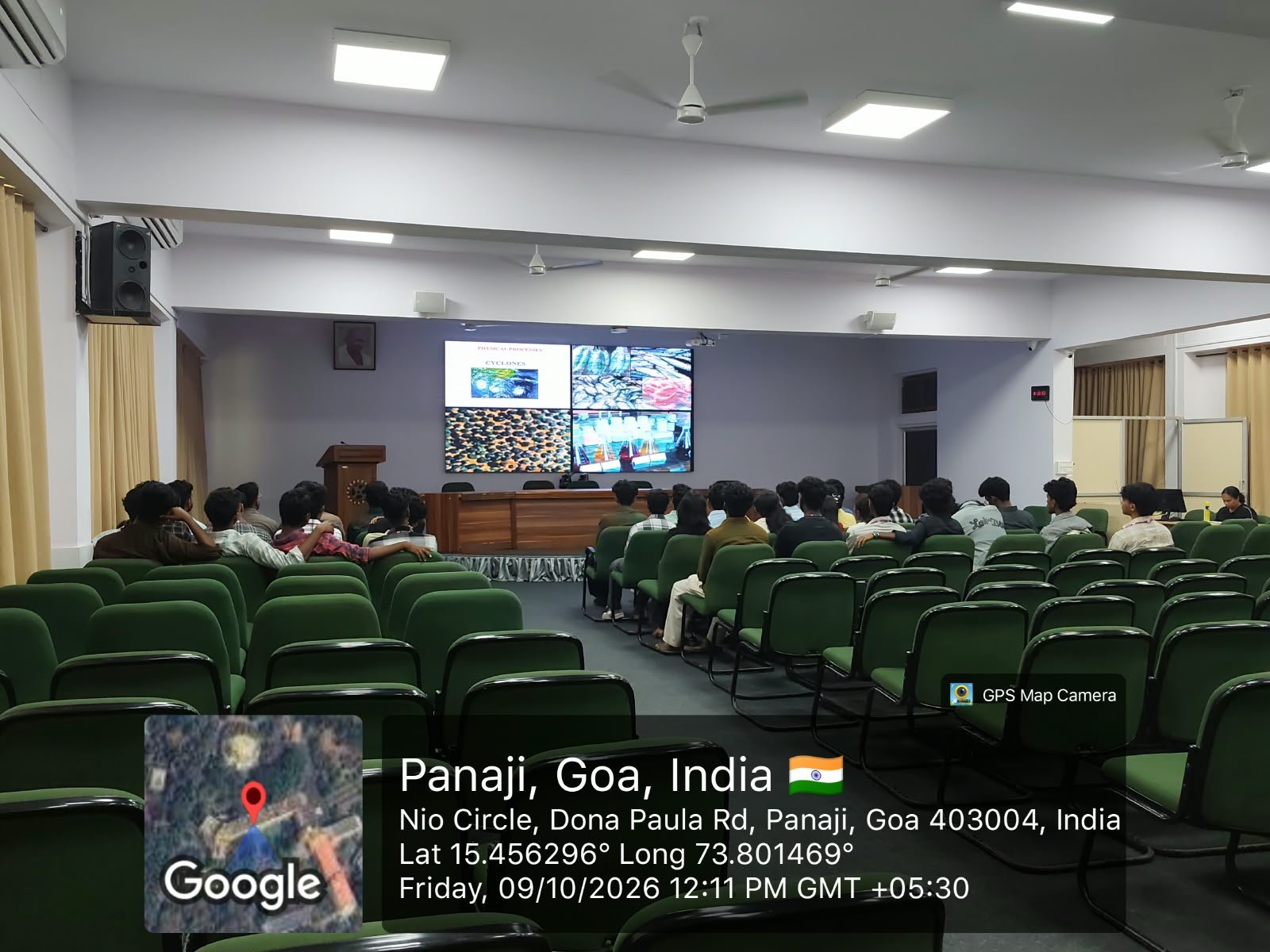
The students then attended a presentation in the institute’s auditorium, which covered topics in ocean science including physical ocean processes such as cyclones and marine life. The students listened to the presentation and learned about the work carried out at the institute.
5. Learning Outcomes
Through the visit, students were able to:
- Gain first-hand exposure to the working of a national research institution.
- Understand the scope of ocean science and why ocean and environmental research matters for society.
- Become aware of the technologies used in ocean research, including robotics, sensors and data-driven methods.
- Appreciate the role of computing in scientific research and the career opportunities in research institutions.
- Recognise the need for continuous learning and curiosity in science and technology.
6. PO and PSO Mapping and Justification
The visit is mapped to the following Programme Outcomes (PO) and Programme Specific Outcomes (PSO). Primary mapping indicates a direct and strong contribution, and secondary mapping indicates a supporting contribution.
| Outcome | Justification |
|---|---|
| PO7 Environment and sustainability | Students were exposed to ocean and environmental science, including physical ocean processes such as cyclones and marine life, and to the research that supports a healthier ocean and sustainable development. |
| PO12 Life-long learning | Seeing research at a national laboratory showed students how technology and science keep advancing and why continuous learning is needed. |
| PO6 The engineer and society | Students saw how scientific and engineering work in oceanography serves society, for example in understanding cyclones, protecting marine ecosystems and supporting coastal communities. |
| PO5 Modern tool usage | Students saw modern technologies used in ocean research, such as the underwater robotic platform on display, and the role of computing, sensors and data in such work. |
| PO10 Communication | Students attended a technical presentation, listened to scientists and the institute staff and documented the visit in this report. |
| PSO1 Professional skills | Students saw how hardware such as sensors and robotic platforms works together with software and data systems in a real research setting. |
| PSO2 Design and development skills | Students saw how software and computing can be applied to scientific, environmental and social needs such as data analysis and forecasting. |
9. Conclusion
The visit to CSIR-NIO, Goa, was an informative and inspiring experience for the students. It gave them exposure to ocean science and research beyond the classroom and showed them how technology and computing contribute to understanding the environment. The Department of Computer Science and Engineering thanks the management and staff of CSIR-NIO for hosting the students and for their time and cooperation, and the accompanying faculty members, Dr. Juby Raju and Prof. Selvan P, for coordinating the visit.
To view detailed report, click on View Report on the right panel.
Date
09 October 2026
Venue
CSIR – National Institute of Oceanography (NIO), Raj Bhavan Rd, Dona Paula Jetty, Panaji, Goa
Chief Guest